
Six Short Books that Pack a Punch

Slim Books with Heft
Recently I've been seeing "Ten Before the End" posts about the ten books readers want to tackle reading in the ten weeks before the end of the year (we're down to about eight and a half weeks now!), and some of us have Goodreads and other reading goals for the calendar year that we're side-eyeing. I thought I'd enable all of this book counting and logging with some Bossy short book suggestions.
As we enter into the busy holiday season, slim books can also suit fractured attention spans and schedules that include limited free time. I sincerely hope you're able to carve out long, luxurious spans of reading and sink into chunky doorstops of books. (Maybe in Cozy January?) In the meantime, here are some Bossy ideas for single-sitting reads.
You might also like these other slim books.
I'd love to hear about your favorite short reads!
01 Foster by Claire Keegan: 128 pages

In Claire Keegan's short novel Foster, Keegan offers a gorgeously wrought Irish story of childhood, hope, love, and loss that is spare, lovely, heartbreaking, and brought me to tears.
In Foster, a young girl in Ireland is taken by her unreliable, frequently drunk gambler of a father to spend the hot summer with previously unknown-to-her relatives, a couple living on a rural farm.
Her bitter mother has just had another baby, and her various other siblings are fighting for resources. Her home life is hectic, hardscrabble, and emotionally cold, but she has never known life to be any other way.
The loving, affectionate household in the country allows her to feel more open and secure than she has before. She has plenty to eat, useful work to do, she learns to love books, she finds laughter. She can't help wondering if she might possibly be here to stay of if she'll be thrust back into her rough home, and which she'd prefer. Summer is ending, and there's a mysterious, unspoken, dark undercurrent at the Kinsellas'.

I absolutely adored this book. It's beautiful, spare, and powerful. I was brought to tears at the end. I'm in for all Claire Keegan books forever
For my full review, check out Foster.
Keegan is also the author of the wonderful novel Small Things Like These and the riveting short story collections Antarctica and So Late in the Day.
02 Volatile Memory (Volatile Memory #1) by Seth Haddon: 176 pages

Seth Haddon's slim science fiction debut offers action and a risky space quest, revenge, and love, but it's also a poignant, lovely story about being seen for your true self, being vulnerable, and thinking beyond traditional standards.
Wylla's ship has seen better days, and she's desperate for a break. When she catches wind of a valuable, mysterious piece of technology on another planet, she banks on her wiliness and speed to beat other treasure hunters to it.
Wylla's own mask is outdated, and scavenging the cutting-edge mask would give her powers she couldn't have dreamed of. Masks bestow upon the wearers the instincts, abilities, and reaction times of the animals after which they're modeled. But the mask Wylla is after also turns out to be sentient, and if she's going to wear the mask, she'll need to work with the mask's creator and help it seek vengeance for past injustices.

I love a ragtag crew on a quest (you can check out other titles with this theme that I've reviewed here), and Volatile Memory is action-packed entertainment, but more importantly it's poignant, exploring issues of bodily autonomy, transgender characters, characters without bodies but with sentient selves, duty and loyalty, revenge and ruthlessness, and mercy and grace.
This slim science fiction novel packs a punch. I can't wait to read more of this immersive world and of Haddon's compelling story.
For my full review of this novel, please check out this link.
03 Transcription by Ben Lerner: 144 pages

Lerner's short novel offers three distinct sections. In the first, a pivotal, wandering interview fails to be recorded; then the "reconstructed" aspect of that interview becomes clear; and ultimately, issues of memory, parenthood, technology, art, faulty recollections, and forgiveness shape the story.
The unnamed narrator of Ben Lerner's short (144-page) novel has traveled to interview his 90-year-old mentor Thomas (who is also his best friend Max's father) to write what will likely be the art world giant's final published interview.
But when the narrator drops his phone in the hotel sink beforehand, he arrives at Thomas's home without a way to record--and whether due to embarrassment, an unexplained inability to shift plans, or what seems to be a mysterious compulsion, he is unable or unwilling to reveal this fact.
Memory, technology, parenting, vulnerability, dreams, and faulty recollections all shape the book's events and its characters.
This was a fascinating, brief read. The sections felt somewhat disjointed, but the final portion of the book was lovely and drew the points of view and elements together.
Click here for my full review of Transcription.
04 I Who Have Never Known Men by Jacqueline Harpman: 208 pages
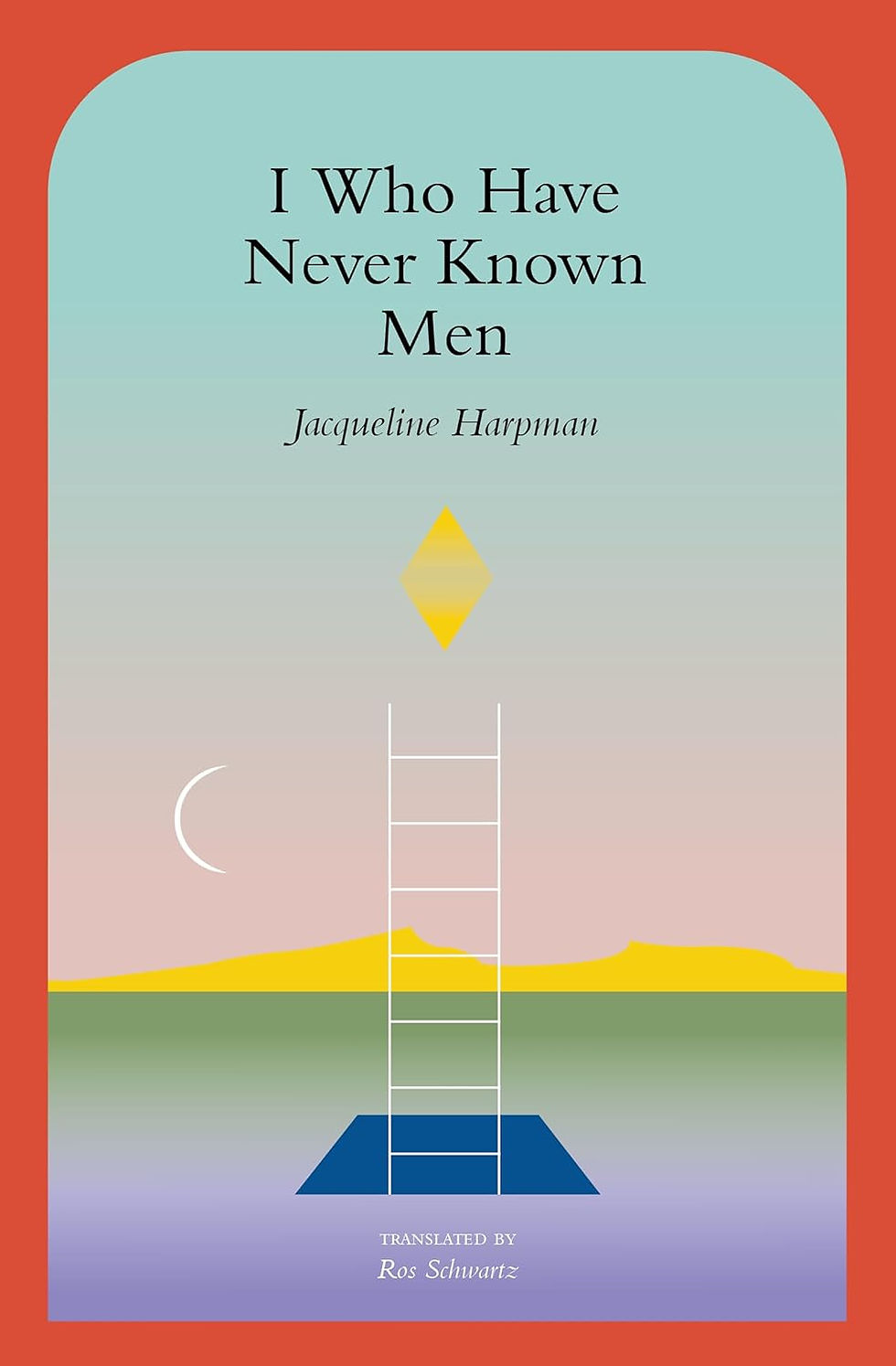
Harpman's slim novel poses a mysterious situation without promising concrete explanations. Our main protagonist knows little about her situation or location, yet persists in her quest for answers and builds a rich inner life filled with wonder.
Forty women (one is a young girl, our main protagonist) live year after year as prisoners in an underground cage. Male guards come and go, feeding the women minimal rations and never speaking.
The women have no recollection of how they came to be in this place, and no information is forthcoming about why they are trapped there. They are not allowed to touch each other but may speak, and to bond and pass the time, they share stories of their past lives, bicker over infinitesimal variations in how they may prepare their food or sew their own clothing, and simply kill time until their almost certain death inside the cell.
Then a blasting alarm sounds, the nearest guard drops his keys and flees, and the women scramble for an escape they never anticipated. But what awaits them on the other side of the bunker doors?

The novel's tone doesn't assure a satisfying set of answers as to why the women were chosen for this imprisonment, insight into what its purpose might be, or details as to its location.
Yet I was intrigued by the post-apocalyptic, puzzling situation and by the main protagonist's persistence and rich inner life, which exists in stark contrast to the physical barrenness that seems to surround her.
For my full review, please see I Who Have Never Known Men. For more postapocalyptic and dystopian stories I've Bossily reviewed, please check out the titles here.
05 A Psalm for the Wild-Built (Monk and Robot #1) by Becky Chambers: 160 pages

Chambers's slim book explores a man's search for meaning--and how a robot's simple questions about maintaining the status quo might open up a world of new possibilities.
In A Psalm for the Wild-Built, the robots vanished from Panga centuries ago, and accounts of a world where they existed are beginning to feel more and more like folklore.
But tea monk Dex finds himself wandering and yearning--for long-lost crickets' nighttime noises, and for some deep connection he can't quite identify.
When Dex wanders into the forest and encounters a robot, the traditional exchange must occur, of checking in, and the robot asks: What do humans need? Dex can't imagine being able to answer this enormous question, but the robot wonders if the matter is really so complicated after all.
The story is full of heart and strange, captivating details of Chambers's imagined world--and of an unorthodox friendship that could save both monk and robot.
For my full review of A Psalm for the Wild-Built, please click here. For more Bossy reviews of Becky Chambers novels, check out the titles at this link.
If you're interested in books about robots, you might also like the books on the Greedy Reading List Six Great Stories about Robots, Humans and Alien Life, and AI.
06 Clear by Carys Davies: 224 pages

Davies's slim, luminous, heartbreaking novel sets a story of isolation and human connection against the brutal removal of impoverished citizens from the land in mid-19th century Scotland.
Davies sets her stark, beautiful story Clear against the backdrop of the Scottish Clearances of the 19th century, in which impoverished citizens were driven off their land.
John Ferguson, a minister in need of funds for his new church accepts the job (against the advice of his wife) of evicting Ivar, the sole inhabitant of a remote island off the northern coast of Scotland in 1843. A series of events leads from disaster to recovery, to connection and secrets, to a surprising set of revelations.
The men develop a tender, heartwarming friendship separate from class, background, intellect, and societal expectations. John, at a distance from worries about his congregation and the future of Presbyterianism, as well as from his kind wife, sinks into Ivar's daily rhythm of working on the land, caring for animals, and finding wonder in nature.
Time passes as though in a vacuum, and the men's need for human connection overshadows all else. By the time John's wife appears--fresh from a rough sea journey, inspired to travel by a sense that John was in danger--the resolution feels heartbreaking, heartwarming, and utterly surprising in its generosity and departure from societal norms.
For my full review of this book please see Clear. For Bossy reviews of other novels with Scottish settings, please check out these titles.


Comments